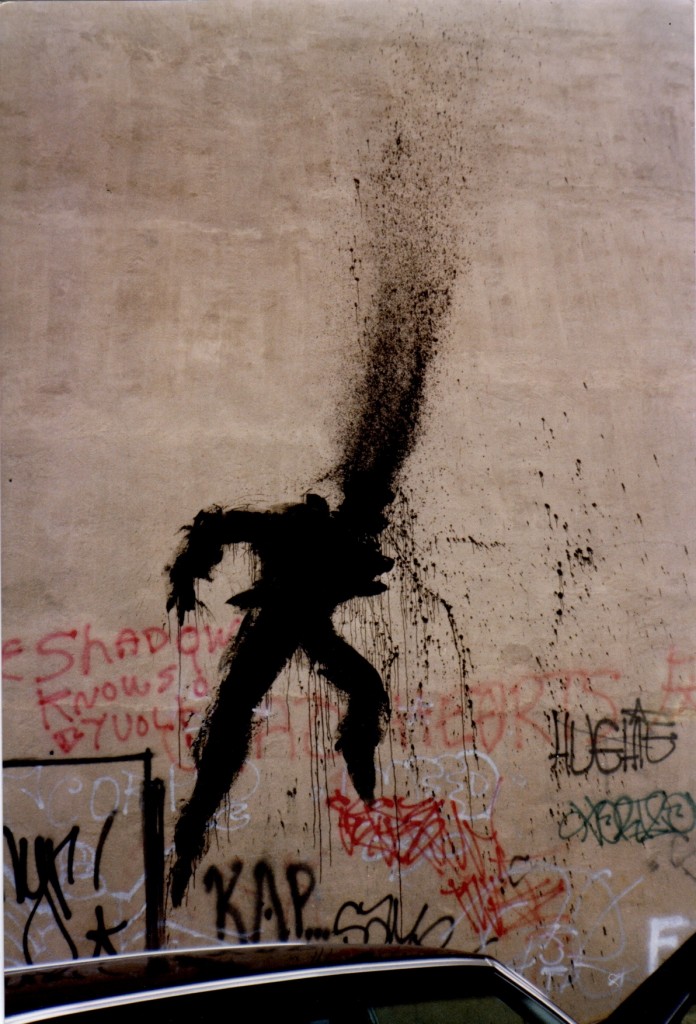



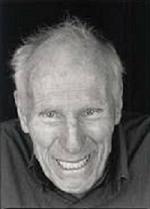
We regret to announce that Mike Golden, the founder and guiding light of Smoke Signals, passed f… Read the rest »
BEEN TO THE MOUNTAINTOP, WENT OVER THE EDGE:
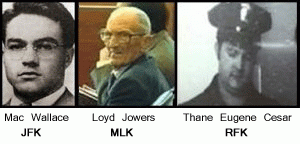
WHO KILLED JFK, MLK & RFK
GREAT MOMENTS IN SPORTZ
23 SKIDOO
Renfreu Neff’s
(NAKED LAMBCHOPS FOR LUNCH)
Ernest Hemingway’s
THE KILLERS
A BUM LOVE STORY
Viola and B. Prune reverently continuing the tradition of Damon Runyon

FUG YOU
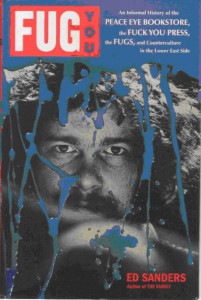
“Now Dig This”
The Terry Southern Interview
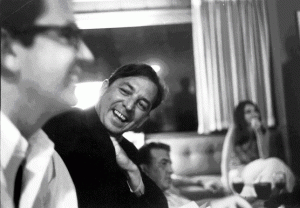
Mike Golden’s
“THERE ARE NO RULES,
SCUMBAG MAKES THE RULES!”
fiction
excerpted from the novelVIRTUALLY REALITY
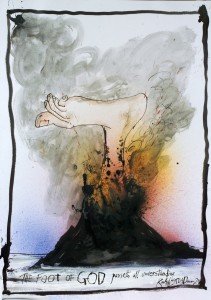
Bukowski’s
WON’T YOU BE MY VALENTINE?
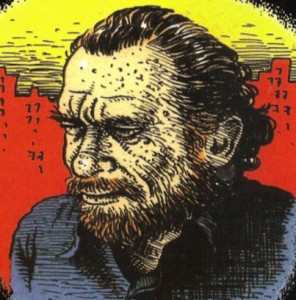
- A Thanksgiving Prayer from William Burroughs
- Thanks for the wild turkey and passenger pigeons destined to be shit out through wholesome American guts... Thanks for vast herds of bisons... Thanks for bounties on wolves and coyotes...Thanks for a nation of finks. »
A WHITER SHADE OF PALE

- Jim Harrison’s “Corruption”
- Like Afghanistan I’m full of corruption. My friend McGuane once said, ”I’d gladly commit a hundred acts of literary capitulation to keep my dog in Alpo. “ The little ones needed dental braces and flutes, cars and houses. Off and on I’ve had this dangerous golden touch like a key to a slot machine streaming 20-dollar gold pieces. It was so easy to buy expensive French wine that purges the grim melancholy of livelihood, the drudgery of concocting fibs. I know a man, happily married, who bought a girl a hundred-dollar pair of panties. I was stunned. For this price I buy a whole lamb each fall. Now the lamb and panties are gone though the panties might be on a card table at a yard sale. Right now a wind has come up and there’s a strange blizzard of yellow buds outside my studio. »
- TALES FROM THE OLD STASH
Jack Wesley Hardin’s
MEXICAN SWEAT (a smuggler’s memoir)
#9 THE FINAL EPISODE
- Gordo ordered them on their knees. There were 24 men and women, all wearing the same type backpack. There were two dark-skinned Mexicans that Sangrita had disarmed. They were the “Coyotes”, the guides that took part of the thousand dollar per person ticket to ride that these poor people paid to have a risky »
-
The Further Adventures of Bart Plantenga's
Confessions of a Beer Mystic #36
The Final Episode
I breathe into my palms. They are swollen by beer and excitement. But I am afraid that the he that is him is now me. I remember my fear of heights. But it wasn’t a fear of heights as much as a fear I might be compelled to jump. I Wonder how it will feel to die. Wonder if I should do it in public, if there’s a quick way to write a will. Times Square perhaps. Quickly and slowly. »- FAMOUS LONG AGO REDUX:
Raymond Mungo’s
SILK ROAD MAHABHARATA #21
(The Final Episode)
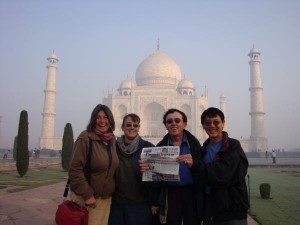
- Travel is broadening, as they say, and also flattening – we were elevated and also humbled. Every day on the Silk Road had seemed like a week, every week like a month, in the sense that travel extends your life, buys you time. And time, dear friend, is running out. »
- Maureen Owen’s
ON A POEM ABOUT ELVIS PRESLEY
but for Ted Berrigan who understands momentum
- I thought she said “There’s a bullet hole in my skull the size of Detroit” He got older but what he really lost was the energy of life he had this energy then he lost it because what happens is you start to see the outcome see where it’s all headed & So you don’t want to go there anymore but there’s already nowhere else to go so Fuck it is all you can think it stops making any sense then & confusion sets in & you don’t want to lose everything you’ve worked your ass off for but there’s no real reason to try to maintain it either Then you start getting fat which he did...»
Keith Olbermann Special Comment:
The Four Great Hypocrisies of the Debt Deal
Welcome to Times Square

Happy New Year
Sex, Death
& Other People’s Money
Sex, Death
& Other People’s Money
& Other People’s Money
This here excursion of three stray dogs lookin' to hide out of the holy night is something else: Silent, clandestine, completely indulgent, yet valid, unlike flogging your hype. . .Last night, blessed be His name, I thought I might find a miracle out there among the trees and one hundred percent Vermont maple syrup...»

Columns
- Bukowski’s (all new)NOTES OF A DIRTY OLD MAN
What about fame? They ask me. Will fame destroy you? Well now, if I am famous and if it destroys me (meaning my talent) then sixty one years of my life will have gone by without my having sense any of the traps... » - Jim Harrison’s THE DEAD FOOD SCROLLS #5
One wonders, doesn't one, why historically we are insufficiently wily in foreign affairs. Without question it is because we do not eat vividly. more... » - Mike Golden’s APOCALYPSE WHEN?
He would always notice the spiderwebs.“We’re smoking them now,” he cackled. Which was when I realized the right half of my body was totally paralyzed. “Mine too,” he whispered. more... »
- ART RAVES ON about JFK conspiracy books, films, etc...
- ASSASSINATION BY OMISSION: GERALD POSNER
-
Courtesy of The Exiled -
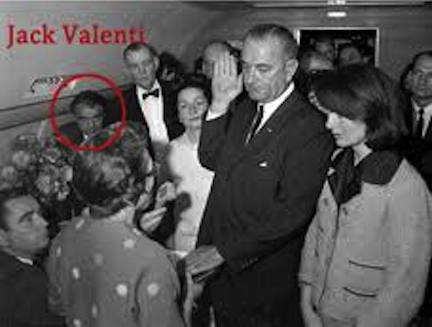
The 49th Anniversary of having to ask Though they probably don't have the balls to do it, the best opportunity Trump will ever have to be trusted by the great majority of Americans would be by using MLK's 86th birthday to name who’s really responsible for the assassinations of JFK-MLK- RFK, before bad-politics-as-usual buries the truth again forever… »
WHO KILLED JFK, MLK & RFK 
- Dave Hill’s LOVE REPORT with Venus & Serena
- Victor Harwood Interviews Regis Debray
- HATE MAIL: ASK DR. FAUSTROLL, PATAPHYSICIAN
If you’ve got the balls to ask our resident psycho-genius “How much more meaningless has life become during the Obaminable age of Social Networking?” do so at your own risk, you pussies more... » -
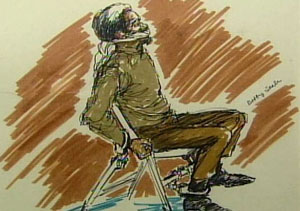
- Darius James' FREE BROTHER BOBBY
Sometime between the ages of eight and nine, traumatized by The Story of Dr. Doolittle, and his adventures in Hugh Loftig's whimsical Africa, wherein a cannibal the color of coal, and suited in an armor of rusty mop-buckets, was bleached by the titular hero to aid said cannibal in his quest for the heart of a fairyland lass, I forsooked the insidious charms of children's literature, embarking on an investigation of works consigned to disreputable -- nay, lunatic -- realms of public inquiry. more... » - Renfreu Neff’s SLEEPING AT THE MOVIES
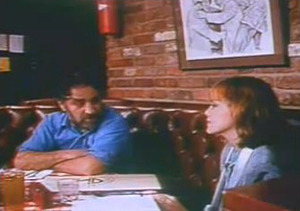
As William Burroughs starts to explain why he always orders lamb chops in restaurants, Allen Ginsberg leaned over and confided to me that he & Bill (he eschews the deferential “William”) have had sex since the latter’s recent return. more... »
Mikhail Horowitz & Paul Austin
in SECOND COMING
-
Trailer of the 1987 East Village Film about the return of you know who to the lower east side. more... »
-
Jane King’s NURSE JANE
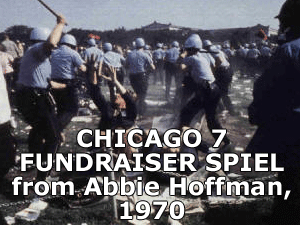
Two years ago I went to the hospital to visit a sick friend who just so happens to edit this mag, only to find he was being tortured by a sadistic nurse. At the time I had already developed an elaborate theory about nursing as an apt profession for sadists, so I put the booga-booga on the booga-booga she had put on my friend more... » Nancy Cohen’s MY DINNER WITH ABBIE -
- Rudy Wurlitzer’s The Drop Edge Of Yonder
The Captain and the Portuguese crew were afraid to set foot on land, convinced that the entire West Coast had been seized by a biblical conflagration; a disaster brought on, they had no doubt, by the godless scum of the earth » -
Buddy Godox’s
REGULAR JOB
Buddy Godox’s moving and pathetic performance of “Regular Job” from Mike Golden’s 1987 East Village film, “Second Coming.” Would you hire this guy?» - Bob Zmuda's Mr X Chronicles #3
“Anyway, so we’re in Jersey, drivin’ along in the limo, and Mr. X sees this bakery, and says, ‘Driver stop over here, I want a glazed donut. Okay, so inside, it’s midday and there’s a few people in line, so X just blurts out, ‘I want a glazed donut,’ real loud, like they’re all just hard of hearing, and this woman behind the counter, her name badge said ‘Flo’ » - The Buddhist Third Class Junkmail Oracle
Who killed d.a. levy? The last poet in America put of trial for the language of his art » - Sparrow & Foamola @ St. Marks Church
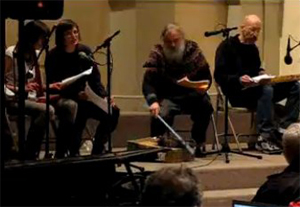
- Foamola has been described as "the best band since the Crimean War" by the Milwaukee Courier-Dispatcher. Since 1990, their frequent melodies have cheered the Lower East Side, and occasionally Soho.
- The Ballad of WHO KILLED MLK
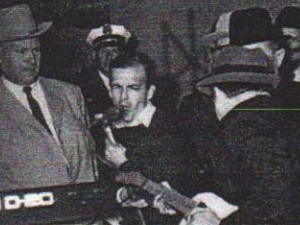
- Obviously, politics breeds strange bedfellows, and those bedfellows have been known to breed more than a few conspiracies hiding behind generic government cover-ups, i.e., such as the blatant cronyism behind war profiteering and the oil companies’ windfall profits at the expense of the rest of the economy. And while we’re at it, let’s not... »
- MODERN (You Call This) LIVING
Joey Amdahl’s TRYING TO BREAK YOUR HEART
- She woke up before noon, which is something she had not done for two or three years. Before she showered, she went for a jog. She came home, turned up her music, and practiced yoga for an hour. After her shower, she stood on the couch and pulled down the poster of George Clooney »
Shameless Gratuities?
- An excerpt from the novel SLOW FADE
by Rudolph Wurlitzer
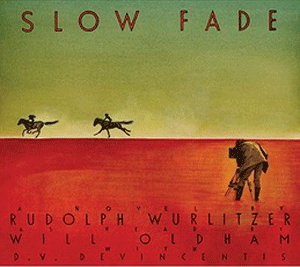
- He was up fourteen grand. He decided to keep four for himself and give the rest to Walker as payment for the next installment of the script, making himself the producer. He would have Walker sign a paper saying all three of them owned the script equally. This was his move. … »
The Blood Of A Wig
BETWEEN A ROCK & A HARD-ON
BETWEEN A ROCK & A HARD-ON
How about sex offenders photos digitally installed in urinals & toilet bowls all over the country? They’ve got to feel it for what they did, not feel it for getting caught doing what they did. »
TO SAVE THE DAY
TO SAVE THE DAY
Google & Facebook have given all our info to the CIA, FBI and the NSA where we’re kept under-the-file-name TIT-SUCKER or TOE-SUCKER or whatever-pet-proclivity- our-SUCKER-don’t-want on the National Enquirer front page. »
 »
» »
» »
» »
» »
» »
» »
» »
» »
» »
» »
» »
» »
» »
» »
» »
» »
» »
» »
» »
» »
» »
»




MACACA SPEAKS
MAKE FRAGMERICA GREAT AGAIN
THE BRAND ON TRUMP’S BIG FUCKING WALL
Truly, we’re fucked if we can’t call off and reschedule this whole lose-lose election the failed two-party-system has stuck us with in order to keep control of the country. In order to change things it's going to take a plan that bars anyone who ran for POTUS in this election and replaces them with... »
THE ONE THAT GET AWAY
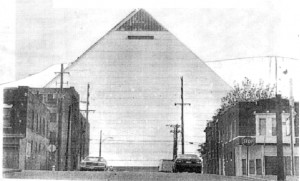
If you unlucky enough to be out in the soup tonight, baby, you don’t have to be told this toxic brew of critics and crucifiers alike is not pissin’ chicken soup for the soul down on us. All you gotta do is watch the waves of rage exploding out over the high bluffs above... »
I AM FIFI
I am FiFi (not my real name), the French maid sex slave of two beautiful, brilliant, strong Amazon Lesbians. And though they tell me I am badly flunking the French part of my maid, What, Dear Vibrator, I must ask, is the correlation between pain and sexual excitement? Am I a sickness? »

As she obliviously barked on, I looked out the corner of my eye to see if everyone was staring at us. But they were totally frozen in time. I mean, they were all completely stuck in mid chew, or suck, as they case may be -- trapped in the unconscious flytrap of our... »
The Big Dumb Nothing
fiction from MODERN (you call this) LIVING

See my thirty-five-year-old boss Betty Allen standing at the door of the club. She scratches at an itch that’s under her tight black skirt and her hand yanks up her fish net stocking at the knee. . A tattoo of a zombie geisha fills up her entire upper arm. The tattoo goes against..... »
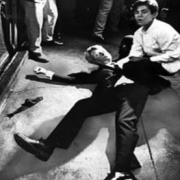
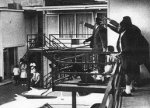
WHO KILLED JFK, MLK & RFK
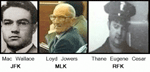
Though they probably don't have the balls to do it, the best opportunity Trump will ever have to be trusted by the great majority of Americans would be by using MLK's 86th birthday to name who’s really responsible for the assassinations of JFK-MLK- RFK, before bad-politics-as-usual buries the truth again forever… »
Six Inches

Sarah picked me up and placed me down between her legs, which she spread open just a bit. Then I was facing a forest of hair. I hardened my back and neck muscles, sensing what was to come. I was jammed into darkness and stench. I heard Sarah moan. Then Sarah began to move me slowly back and forth. As I said, the stench was unbearable, and it was difficult to breathe, but somehow there was air in there—various side-pockets and drafts of oxygen. Now and then my head, the top of my head bumped The Man in the Boat and then Sarah would let out an extra-illuminated moan. Sarah began moving me faster and faster »
MINGUS SPEAKS
Avant-Garde and Tradition
Photograph by Robert Frank
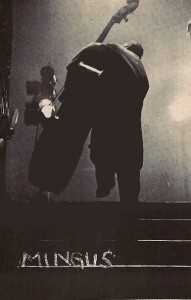
I don't want to be so junglish that I can't climb a stairway. I got to climb mountains all day long? We're going to the moon, right? Well, I'm with the guys that wrote music that got us to the moon. Not the guys who dreamed about it. Bach built the buildings, we didn't... »
THE LAST INTERVIEW WITH JAMES EARL RAY
A Counter Myth
from Mike Golden’s
BEEN TO THE MOUNTAINTOP, WENT OVER THE EDGE
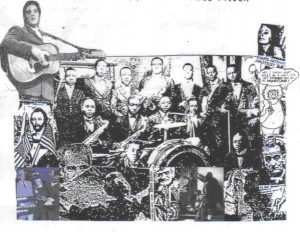
Sad to Say, if you ask any graduating class today who James Earl Ray was, less than 10% of those over-priced diplomas would know the confessed, then-unconfessed, alleged-assassin of Dr. Martin Luther King was indisputably one of the three biggest hand-picked-stooges in history, along with Curly Larry Sirhan and Mo Harvey Oswald... »
A Thanksgiving Prayer from William Burroughs
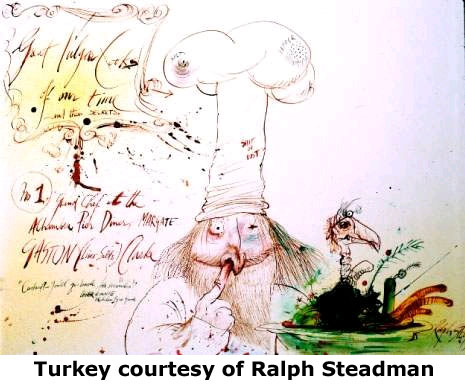
Thanks for the wild turkey and passenger pigeons destined to be shit out through wholesome American guts... Thanks for vast herds of bisons... Thanks for bounties on wolves and coyotes...Thanks for a nation of finks... »
THE WRITERS’ CONFERENCE
excerpted from his novel
TO DIE IN MADRID
That Saturday night Malraux and I sat side-by-side, facing the room, watching the crowd flow in and out in waves as it passed through the Dingo, quick to find out what was doing in the Quarter, savor a Jimmy Charters Gin Fizz and head off for dinner at the Brassarie Lipp or the Dôme... »
Now entering the 50th year of having to ask
WHO KILLED MLK
HERE’S A CONVERSATION
WITH PRIVATE INVESTIGATOR WILD BILLY HICKS
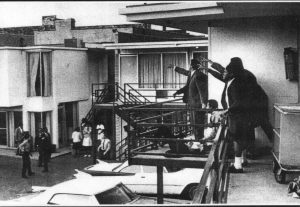
“I’d rather be dead than afraid,” the spirit said to Hicks It was Dr. King’s mantra, but all Wild Billy saw was a poor lost soul who didn’t know he was dead. “I never felt so small as when I realized it was my job to inform Dr. King’s spirit his body was gone »
BOYS TOWN
THE NATIONAL PASTIME
Great Moments in Sportz
Fear & Loathing @
The Kentucky Derby
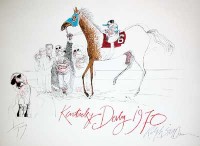
RALPH STEADMAN remembers meeting HUNTER S. THOMPSON: I heard a quick hiss from the spray can Hunter was brandishing. He had Maced me again!...
HUNTER meets RALPH: Another problem was his habit of sketching people he met in the various social situations I dragged him into--then giving them the sketches. »
Inside Outsourcing
WAA!!
WHAT AN ASSHOLE!
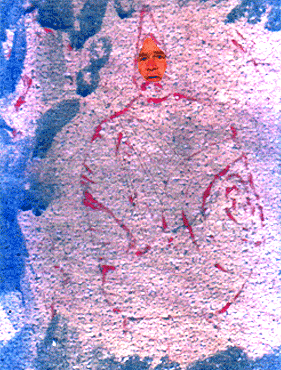
painting collage of UBU, THE DECIDER by aka
Fred Wistow introduces Malcolm Gladwell

The Fire Insider
for daily updates
Missionary Positions
fiction by Joe Maynard
Painting by Peter Cross
"dick lit" is here to acknowledge the good, bad and ugly that goes with it, as it celebrates every young boy's quest to get off the next time, and every old man's quest to get off one more time, before there is no time left to get off on... »
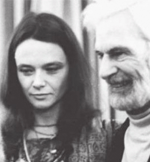
REMEMBERING THE TEA
an excerpt from Ellen Pearlman’s
NOTHING & EVERYTHING
Nothing and Everything is about the relationship of Eastern thought, particularly Buddhism, to the arts in post-war New York City —from the early 1940s to the early1960s—a handful of individuals brought about major changes in music, performance, dance, theater, installation, video, mixed media, painting, and sculpture, as the evolution from modernism to postmodernism broke down the idea of art as a practice devoted to a particular medium. The world—or life itself—became a legitimate artist’s tool, aligning with Zen Buddhism’s emphasis on enlightenment occurring at any moment.... »
Alan Greenberg’s
ROPE-A-DOPING WITH MUHAMMAD ALI
ROPE-A-DOPING WITH MUHAMMAD ALI
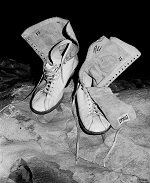
For three hours Ali was in the ring sparring, and the entire time he never threw a punch. When he finally stepped down I asked him what he was doing. “I’m gonna get that sucker so tired of punching me he’s gonna fall flat on his face,” Ali replied. And so the “Rope-a-Dope” was born, not in the ring in Zaire, but in a gym in Pennsylvania. »
MY LIFE & TIMES IN THE SKIN TRADE

Up on the stage a man who looks like Klinger on Mash lifts his dress for the audience to inspect him. He has a clit. An actual clit. Then suddenly the legs spread, and PRESTO SLEAZO, there's a schlong! What a bargain! A real live hermaphrodite is about to take the skin of his female genitalia and stretch it over his male genitalia and get it on with itself »
Great Moments in Sportz
Professor Irwin Corey Accepts
The National Book Award
for Thomas Pynchon
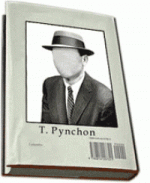
It happened Thursday, April 18th, 1974, at Alice Tulley Hall, and those that were there will never forget it (if they remember it at all). The National Book Awards, commercial publishing’s now defunct version of the Academy Awards was in the bottom of the ninth, down »
Mimi & Richard Farina Live
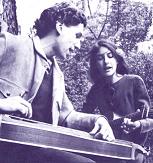
In 1965, Mimi and Richard Farina dropped by the studios of WTBS (now WMBR) with electric guitarist Barry Tashian (of Barry & the Remains) for music and talk with DJ Ed Freeman. Richard is on dulcimer. One of Mimi’s two guitars is tuned like a dulcimer. The explanation for the brief gap in the tape has long been lost.
CLICK HERE
Michael Disend's RIDER OF THE JADE HORSE

Li looked firmly into his eyes. “No! I want man who is also a woman.” Penman nodded against his will, his gaze stealing down toward the strap-on dildo she was generously coating with lube. It thrust out like a red cannon from her leather harness. Why red? Is it because she’s from China?
»

Dick Lit
Stacia St. Owens’
DISCOVERED
“Dick lit” has been around since the first caveman’s curiosity stuck his dick into the equation when he rubbed those two rocks together around it until....
DISCOVERED
Millie tittered, which is how girls used to be taught to laugh. Tilda wondered if this were an intentional jab.
Barney Rosset Interview
(The Subject Was Left Handed)
Nightlife